
Trump’s Approval Deteriorates as Democrats Increase Generic Ballot Lead
The national mood continued to worsen for Republicans in April amid voters’ frustrations over an unpopular war and a lack of focus on domestic issues. The president’s job approval rating deteriorated further and Democrats increased their lead over Republicans for the U.S. House of Representatives. The survey was conducted by BIG DATA POLL as part of the Public Polling Project for April 2026.
Generic Ballot for the U.S. House
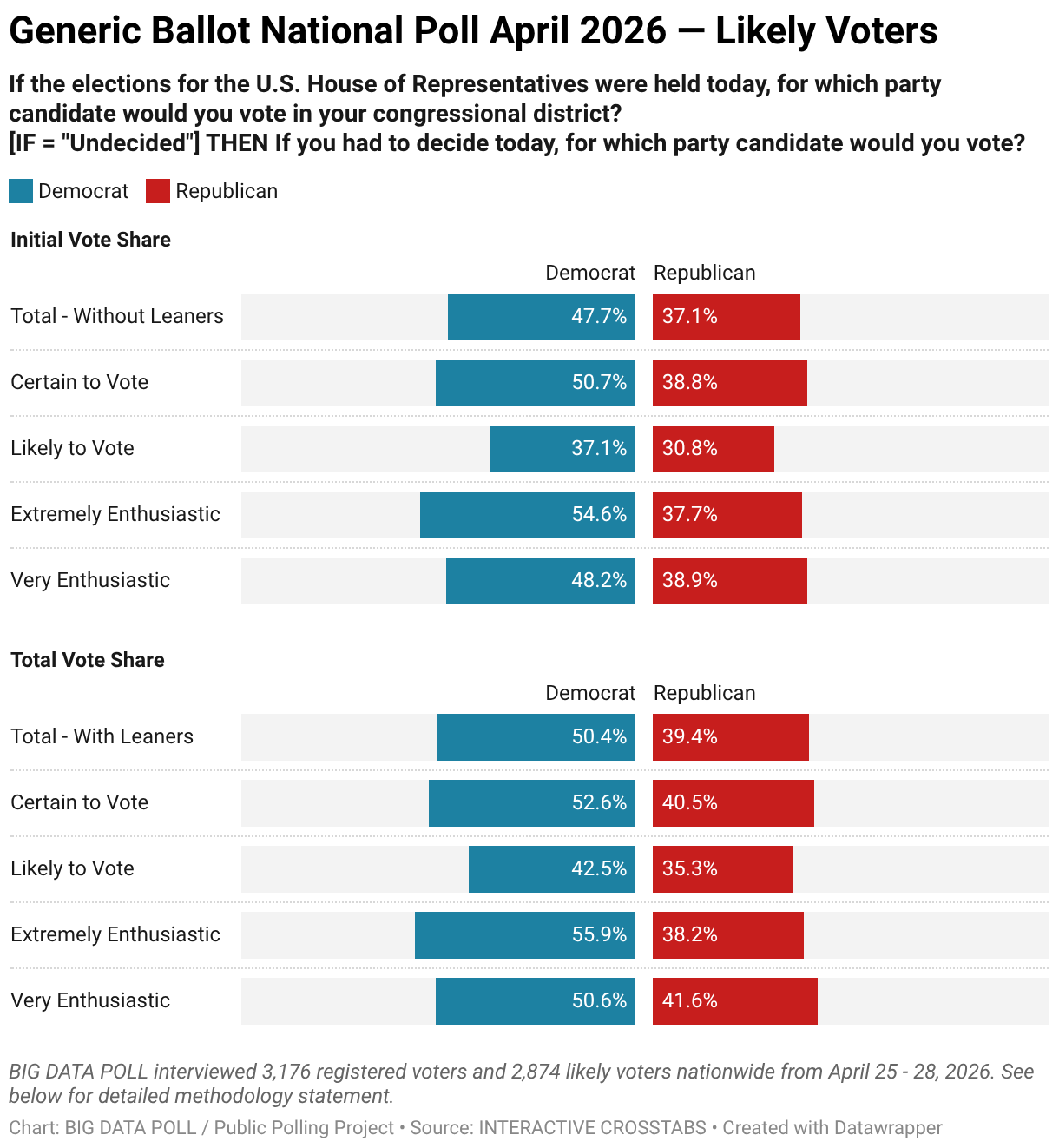
Democrats lead Republicans on the Generic Ballot among likely voters 47.7% to 37.1%, with 5.9% choosing “someone else” and the remaining 9.3% undecided. When undecided likely voters are leaned, Democrats maintain their margin 50.4% to 39.4%.
Worth noting, this is the largest lead for either party on the Generic Ballot ever measured by BIG DATA POLL. It’s being driven by voter enthusiasm, more interest in voting on behalf of Democrats, crossover voting and independent preference both favoring Democrats, and deep frustration with Republicans over their failure to enact domestic policies that alleviate their economic and financial concerns at home.
“After nearly a year of clear warning signs in data collection and as many months of political grace, voters have clearly run out of patience with the administration and his party,” BIG DATA POLL Director Rich Baris, said in a statement. “The one silver lining is that these percentage levels on trust to handle the most important voting issues indicate voters’ current preferences aren’t an affirmation of the Democratic Party.”
“Democrats are simply the alternative to the party in power voters understandably blame for their current situation.”

Presidential Approval Rating
In April, only 39.6% of registered voters approved of the job Donald Trump was doing as President, including just 21.7% who strongly approve. That represents a new low for the president during his second term and just 0.2% away from a dip into the critical 30s. Meanwhile, 56.9% now disapprove of the job the president is doing to include 45.2% who strongly disapprove, also marking a new high for both in the president’s second term.

The Intensity Index—the difference between the percentage of those who strongly approve and strongly disapprove of the job the president is doing in office—increased in negativity in April to -23.5. That’s the widest negative gap measured by BIG DATA POLL for Donald Trump’s Presidential Approval Trend, exceeding the previous record in February measured at -22.3. There is now a larger percentage of registered voters who strongly disapprove of the job the president is doing in office than the total percentage of registered voters who approve.
White House Focus Tracker
Last year, motivated by repeated concerns raised by voters during interviews, BIG DATA POLL created the White House Policy Focus Tracker. It directly gauges voters’ views towards the administration’s, and indirectly measures the where voters prefer the administration to focus their efforts.
In March, the percentage of voters who say the administration is too focused on foreign policy a new high at 62.0%, easily eclipsing the prior high of 56.3% measured in January. In April, the percentage who believe the White House is too focused on foreign policy marginally hit a new record high at 62.1%.
Only 13.0% say they are too focused on domestic issues, and just 24.8% say the focus has been balanced. This should be particularly concerning for the administration and Republicans given the top five most important voting issues in our 2026 Rank Distribution for Most Important Issues are all domestic issues.
“Voters warned the administration and Republicans for months not to go down this road, and they were ignored,” Director Baris added. “You cannot ignore overwhelming consensus and domestic-focused sentiment as they did and expect a different outcome.”
“These results might be seen as shocking, but they are not unexpected.”
Direction of Country: Right Track OR Wrong Track?
The Direction of Country Index started the year with 36.3% saying the country is headed in the right direction, essentially unchanged from the year-end reading at 36.1%. In April, that percentage fell to just 32.0%, the lowest since former President Joe Biden left office in January 2025.
Further, the percentage of registered voters who say it’s off on the wrong track hit 59.7%, the highest since December 2024 and up from last month’s reading at 58.3%. That also marks the widest negative spread since January 2025 at -27.7 compared to just -7.2 in May 2025 before the president bombed three of Iran’s nuclear sites.
Iran War Unpopular, Voters Have No Appetite for War
Only 35.2% approve of the president’s handling of the situation in Iran, including just 20.9% who strongly approve. That compares to 56.9% who disapprove to include 46.6% who strongly disapprove.
Less than 4 in 10 support the U.S. military strikes against the regime in Iran and roughly 1 in 2 oppose it. The military action is unpopular with just about every demographic group except for older Republicans. While the president’s partisan base is willing to give him the benefit of the doubt, even they do not find the war important or necessary and would rather the president focus on domestic issues. Further and most importantly, that base is shrinking as the share of self-identified Republicans remains low, and a range of 12% to 20% slide into self-identified independents saying they “previously identified as America First / MAGA”.
Nearly 8 in 10 voters (75.8%) voters say “it is important for the U.S. to stay out of foreign wars and military conflicts”, up from 70.9% February and including 40.2% who now say it’s “very important”. Last July, BIG DATA POLL found only 24.6% of voters supported such a move in the Middle East, with roughly as many 25.6% saying they believe the U.S. should play no role in the region. The largest percentage and plurality (37.7%) preferred only diplomatic action.
Just about 6 in 10 (59.5%) continue to say the president has not “clearly explained the reasons and goals for the U.S. taking military action against Iran”, while 39.5% say that he has. That’s an identical result to the previous month.
Which party voters trust to avoid war—or, as stated “to keep the U.S. out of foreign wars and military conflicts”—has long foreshadowed popular vote winners both statewide and nationally in surveys conducted by BIG DATA POLL. It was the first sign of trouble for then-incumbent President Trump in 2020 in the Big Six Rust Belt Poll. In 2024, the results forecasted the winner nationally and all battleground states to include nearly identical findings in Michigan and Pennsylvania.
Now, 42.6% trust the Democratic Party more to keep the U.S. out of foreign wars and military conflicts, while just 27.7% trust the Republican Party and nearly as many (21.9%) chose “neither”. In February, Democrats held a much smaller 8-point advantage, 38.8% to 31.4%, and their advantage on this question inched higher since March.
Methodology
The Public Polling Project conducted by BIG DATA POLL interviewed 3,176 registered voters and 2,874 likely voters nationwide from April 25 to April 28, 2026. Interviews conducted online are sourced through Lucid (CINT) and live-agent phone interviews including P2P SMS and text-to-online are sourced from either the L2 National Voter File Database. Participants who opted for text-to-online were given 24 hours to complete the interview. Interview details plotted on maps can be reviewed by hovering and clicking on the locator pins. Results were weighted for sex, age, race and ethnicity, education, and geography. The overall sampling error is ±1.8% for the registered voter sample and ±1.7% for the likely voter sample at a 95% confidence level. It is important to note that sampling errors for subgroups are higher. All BIG DATA POLL publicly conducted surveys are crowdfunded via the Public Polling Project, supplemented if necessary by BIG DATA POLL and are NOT funded by or affiliated with any candidate, campaign, committee, or political entity. Full and interactive crosstabs can be viewed on MarketSight.