
Voters Say Iran War Not Worth Economic Cost, Want Trump to Focus at Home
The midterm outlook worsened for Republicans in May amid rising unpopularity of the Iran War and Democratic advantages on trust to handle issues. The president’s job approval rating deteriorated on the margins and Democrats increased their lead over Republicans for the U.S. House of Representatives. The survey was conducted by BIG DATA POLL as part of the Public Polling Project for May 2026.
Generic Ballot for the U.S. House
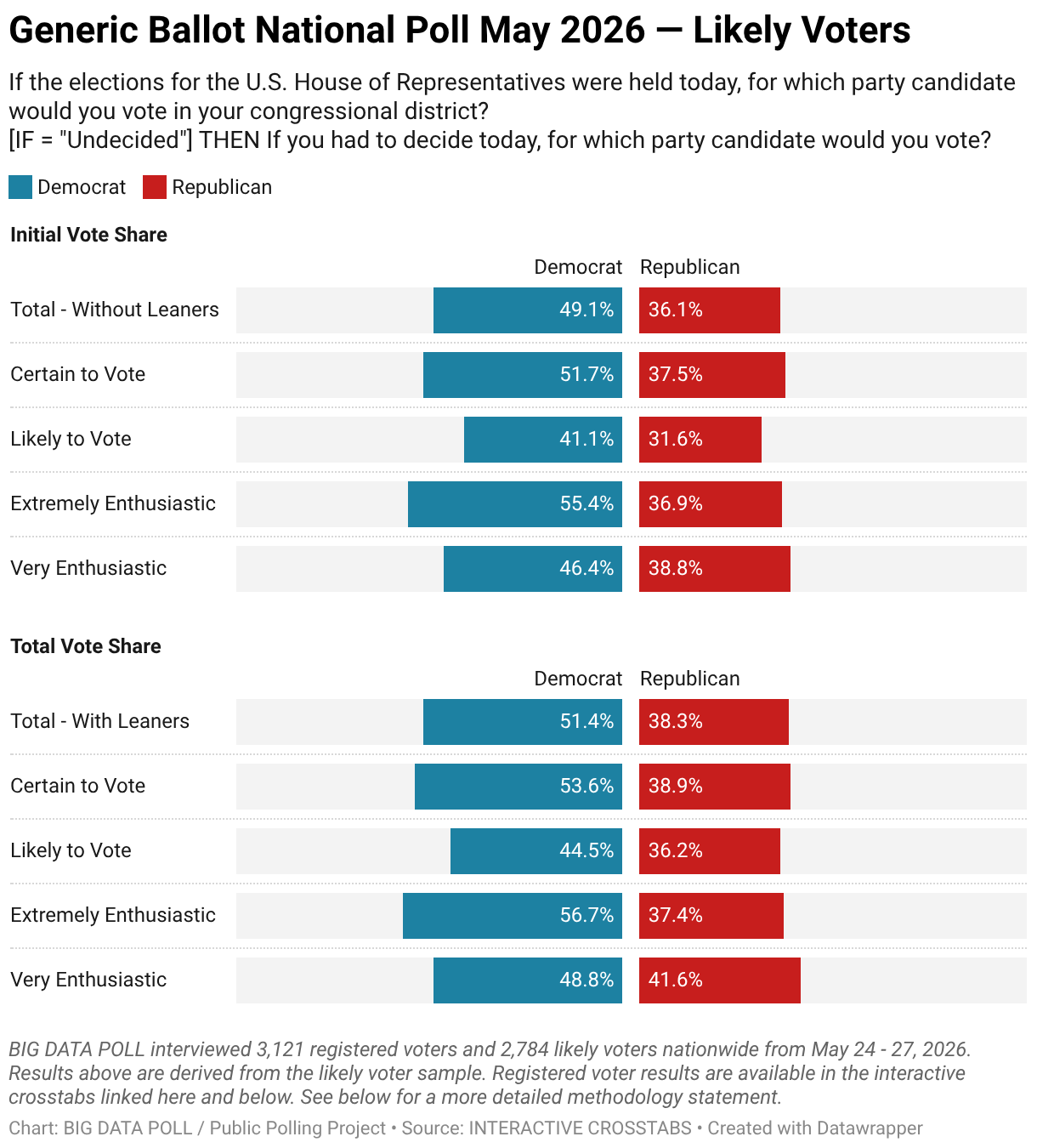
Democrats expanded their already significant lead over Republicans on the Generic Ballot among likely voters 49.1% to 36.1%—up from 47.7% to 37.1% in April—with 7.5% choosing “someone else” and the remaining 11.5% undecided. When undecided likely voters are leaned, Democrats maintain their margin 51.4% to 38.3%, slightly wider than the 50.4% to 39.4% lead last survey.
Worth noting, this is the largest lead for either party on the Generic Ballot ever measured by BIG DATA POLL, eclipsing the prior record set last month in April. It’s being driven by voter enthusiasm, more interest in voting on behalf of Democrats, crossover voting and independent preference both favoring Democrats, and deep frustration with Republicans over their failure to enact domestic policies that alleviate their economic and financial concerns at home.
“After a year of voters making themselves clear while granting an unheard-of amount of political grace, Republicans have dug themselves into a massive hole by not heeding their warnings,” BIG DATA POLL Director Rich Baris, said in a statement. “It’s unclear whether this is just a little noise on top of an already dominant lead posted by Democrats or if they really are inching out on their double-digit lead.”
“But what is clear is that voters have run out of patience with the administration and the majority party, and Democrats now hold considerable leads on trust to handle issues most important to their vote.”

Presidential Approval Rating
In May, only 39.4% of registered voters approved of the job Donald Trump was doing as President, including just 19.9% who strongly approve. That represents a new low for the president during his second term and the first time he has dipped into the critical 30s. Meanwhile, 57.4% now disapprove of the job the president is doing to include 46.2% who strongly disapprove, eclipsing last month and marking a new high for both in the president’s second term.
The Intensity Index—the difference between the percentage of those who strongly approve and strongly disapprove of the job the president is doing in office—increased in negativity in April to -26.3. That’s the widest negative gap measured by BIG DATA POLL for Donald Trump’s Presidential Approval Trend, exceeding the previous record in April measured at -23.5. There is now a larger percentage of registered voters who strongly disapprove of the job the president is doing in office than the total percentage of registered voters who approve.

Voters also gave the president worse grades this month on his report card specific to the issues. He is now negative on his handling of every single issue tested and approval fell to the 30s for each issue save for Immigration/Border Security and Crime/Safety.
Worth noting, President Trump’s approval rating on Inflation / Cost of Living has now fallen into the 20s—the lowest level ever measured for him on the issue—which is currently rated the one most important to voters going into the 2026 midterm elections. Now, only 29% approval and 66.5% disapprove, a -6.1-point decline in the spread.
The second largest decline for him over the month came on Foreign Policy/National Security, though that’s no surprise given how negative voters once again view the Iran War. Only 38.4% approve of President Trump’s handling of the issue and 56.2% now disapprove.
Iran War Increasingly Unpopular, Voters Say “Not Worth Fighting”
Only 33.7% approve of the president’s handling of the situation in Iran, including just 19.0% who strongly approve. That compares to 58.3% who disapprove to include 47.2% who strongly disapprove. All of these represent deteriorations in support for the president on the Iran War from the prior month.
Less than 4 in 10 (36.5%) support the U.S. military strikes against the regime in Iran and a rising majority (53.4%) oppose it. The military action is unpopular with just about every demographic group except for older Republicans. While the president’s partisan base was willing to give him the benefit of the doubt, even they do not find the war important or necessary and would rather the president focus on domestic issues. Further and most importantly, that base is shrinking as the share of self-identified Republicans remains low, and a range of 12% to 20% slide into self-identified independents saying they “previously identified as America First / MAGA”.
Nearly 8 in 10 voters (75.1%) voters say “it is important for the U.S. to stay out of foreign wars and military conflicts”, up from 70.9% in February and including 37.4% who say it’s “very important”. Last July, BIG DATA POLL found only 24.6% of voters supported such a move in the Middle East, with roughly as many 25.6% saying they believe the U.S. should play no role in the region. The largest percentage and plurality (37.7%) preferred only diplomatic action.
Again, just about 6 in 10 (60.1%) continue to say the president has not “clearly explained the reasons and goals for the U.S. taking military action against Iran”, while 39.0% say that he has. When asked, only 36.5% say the Iran War was worth fighting considering the economic costs, while a significant 63.5% majority say it was not worth fighting.
Which party voters trust to avoid war—or, as stated “to keep the U.S. out of foreign wars and military conflicts”—has long foreshadowed popular vote winners both statewide and nationally in surveys conducted by BIG DATA POLL. It was the first sign of trouble for then-incumbent President Trump in 2020 in the Big Six Rust Belt Poll. In 2024, the results forecasted the winner nationally and all battleground states to include nearly identical findings in Michigan and Pennsylvania.
Now, 43.2% trust the Democratic Party more to keep the U.S. out of foreign wars and military conflicts, while just 28.2% trust the Republican Party. Nearly as many (21.2%) chose “neither”. In February, Democrats held a much smaller 8-point advantage, 38.8% to 31.4%, and their advantage on this question has inched higher since March.
Further, a 52.2% majority say Israel has too much influence over U.S. foreign policy. Roughly 1 in 3 (32.9%) say they have none at all, and another 14.9% say they have just about the right amount of influence.
White House Focus Tracker
Last year, motivated by repeated concerns raised by voters during interviews, BIG DATA POLL created the White House Policy Focus Tracker. It directly gauges voters’ views towards the administration’s, and indirectly measures the where voters prefer the administration to focus their efforts.
In March, the percentage of voters who said the administration is too focused on foreign policy set a new high at 62.0%, easily topping the prior high of 56.3% measured in January. In April, the percentage who believe the White House is too focused on foreign policy marginally hit a new record high at 62.1%.
In May, the record has been broken again as 62.4% of voters say the administration is too focused on foreign policy. Only 13.1% say they are too focused on domestic issues, which is comparable to prior months, and just 24.6% say the focus has been balanced. This should be particularly concerning for the administration and Republicans given the top five most important voting issues in our 2026 Rank Distribution for Most Important Issues are all domestic issues.
“Voters could not have been clearer over the last year or so, and yet they have been ignored by the administration and the Republican majority,” Director Baris added. “You cannot ignore voters like this and expect a different outcome.”
“As history has taught us to also expect, it would appear voters are gearing up to punish them pretty badly for it.”
Direction of Country: Right Track OR Wrong Track?
The Direction of Country Index started the year with 36.3% saying the country is headed in the right direction, essentially unchanged from the year-end reading at 36.1%. In May, that percentage fell to just 29.7%, the lowest since former President Joe Biden left office in January 2025.
Further, the percentage of registered voters who say it’s off on the wrong track hit 60.4%, the highest since December 2024 and up from last month’s reading at 59.7%. That also marks the widest negative spread since January 2025 at -30.7 compared to just -7.2 in May 2025 before the president bombed three of Iran’s nuclear sites.
Methodology
The Public Polling Project conducted by BIG DATA POLL interviewed 3,121 registered voters and 2,784 likely voters nationwide from May 24 to May 27, 2026. Interviews conducted online are sourced through Lucid (CINT) and live-agent phone interviews including P2P SMS and text-to-online are sourced from either the L2 National Voter File Database. Participants who opted for text-to-online were given 24 hours to complete the interview. Interview details plotted on maps can be reviewed by hovering and clicking on the locator pins. Results were weighted for sex, age, race and ethnicity, education, and geography. The overall sampling error is ±1.8% for the registered voter sample and ±1.7% for the likely voter sample at a 95% confidence level. It is important to note that sampling errors for subgroups are higher. All BIG DATA POLL publicly conducted surveys are crowdfunded via the Public Polling Project, supplemented if necessary by BIG DATA POLL and are NOT funded by or affiliated with any candidate, campaign, committee, or political entity. Full and interactive crosstabs can be viewed on MarketSight.