
Supreme Court Put the Ball in Republicans’ Court, But Can They Capitalize?
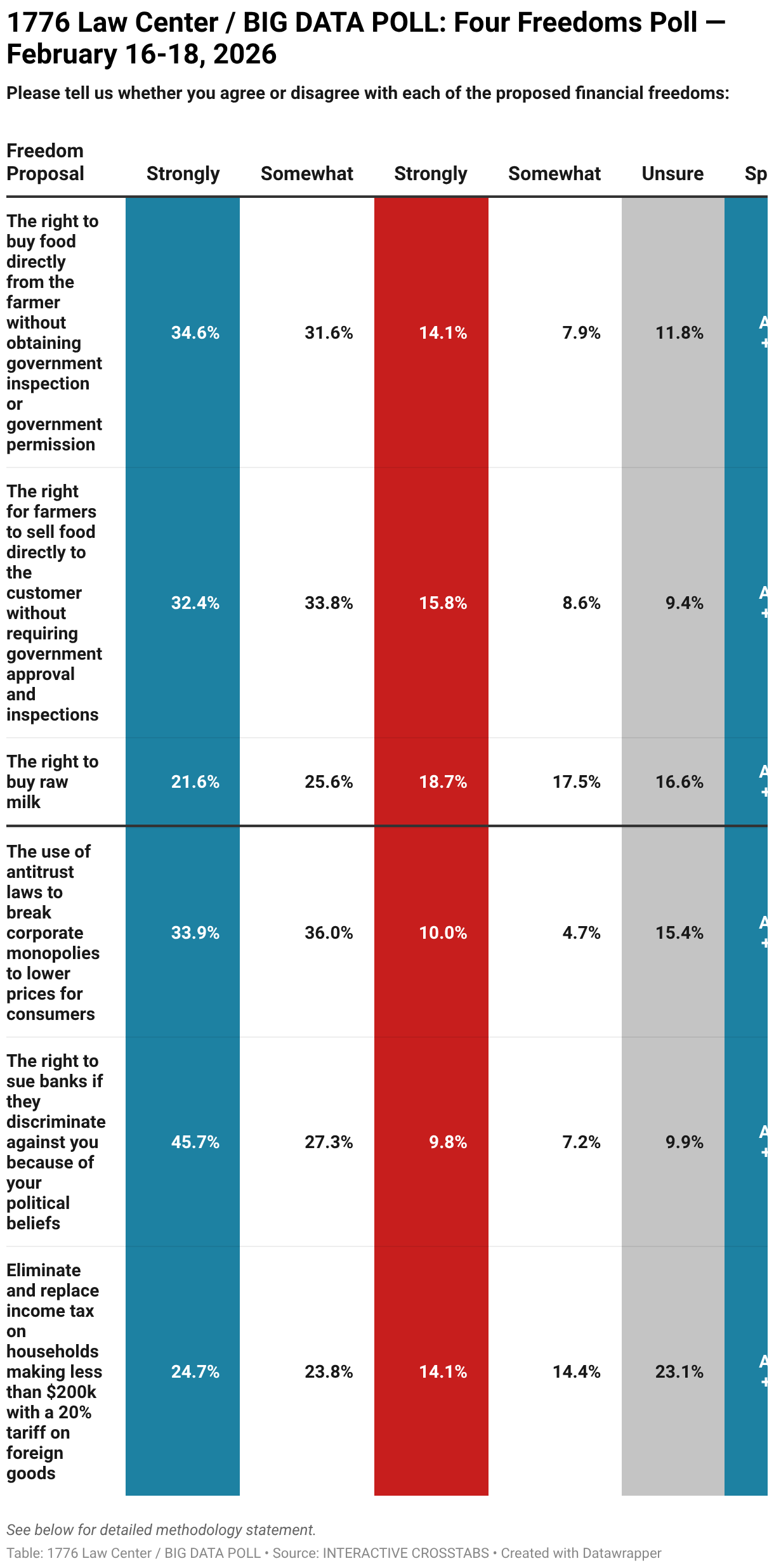
By a 20-point margin, voters back replacing the income tax for those making $200,000 or below with a 20% tariff on foreign goods. The survey was conducted by BIG DATA POLL for 1776 Law Center as part of the annual Four Freedoms Poll in partnership with the Public Polling Project.
Forty-nine percent (48.5%) agree with the proposal, to include 24.7% who “strongly agree” and just 28.5% disagree with it. Only 14.1% feel strongly against it and 23.1% are unsure.
Today, the U.S. Supreme Court ruled 6 – 3 against the White House on a critical case relating to the president’s use of tariffs for industrial policy, rather than just national security.
“The only way to enforce President Trump’s tariffs is to have Congressional approval following the SCOTUS decision,” said Robert Barnes, the civil rights and criminal defense head of 1776 Law Center. “The good news is the public overwhelmingly backs our traditional American approach since the founders — ending the individual income tax on 90% of Americans, replaced by a 20% tariff on foreign goods.”
“That would be revenue neutral and boost the president’s industrial policy priorities.”

Worth noting, the proposal is most popular with prime working-age voters under 50 years old and minorities. The largest majority at 58.2% was reported from voters 30-44, with the largest voting age group 45-64 agreeing by a sizable 50.8% to 25.6% margin.
“These are the voters the administration badly needs to win back over,” BIG DATA POLL Director Rich Baris, said. “While voters 65 years and above are split evenly on the proposal, they are also the most supportive of the president at the moment.”
“Further, there simply are not enough of them to put together a viable coalition national coalition going into 2026 and beyond. Younger voters carried the day for the president in 2024, and his party needs them now more than ever.”
The most popular financial freedom proposal was right to sue banks if they discriminate based on political beliefs. Seventy-three percent (73.0%) agreed with the proposal including 45.7% who “strongly agreed” and only 17.0% disagreed.
The use of antitrust laws to break monopolies and would-be monopolies to ensure lower consumer prices also enjoys widespread bipartisan support. Seventy percent (69.9%) agreed including 33.9% who “strongly agreed” and only 14.7% disagreed.
Methodology
The Public Polling Project conducted by BIG DATA POLL interviewed 2,012 registered voters and 1,805 likely voters nationwide from February 16 to February 18, 2026. Interviews conducted online are sourced through Lucid (CINT) and live-agent phone interviews including P2P SMS and text-to-online are sourced from the L2 National Voter File Database. Participants who opted for text-to-online were given 24 hours to complete the interview. Interview details plotted on maps can be reviewed by hovering and clicking on the locator pins. Results were weighted for sex, age, race and ethnicity, education, and geography. The overall sampling error is ±2.1% for the registered voter sample and ±2.3% for the likely voter sample at a 95% confidence level. It is important to note that sampling errors for subgroups are higher. All BIG DATA POLL publicly conducted surveys are crowdfunded via the Public Polling Project, supplemented if necessary by BIG DATA POLL and are NOT funded by or affiliated with any candidate, campaign, committee, or political entity. This survey was conducted with partnership sponsoring from 1776 Law Center. Full and interactive crosstabs can be viewed on MarketSight. The Four Freedoms Poll is an annual partnership with the Public Polling Project to gauge support and/or opposition to issues relating to food, financial, medical and political freedoms. 1776 Law Center helps those who cannot afford counsel and public advocates to obtain capable, competent counsel and public advocates, especially when their case broadly impacts civil liberties.