Voter Trust in Parties to Avoid War Closely Mirrors Midterm Vote Intention
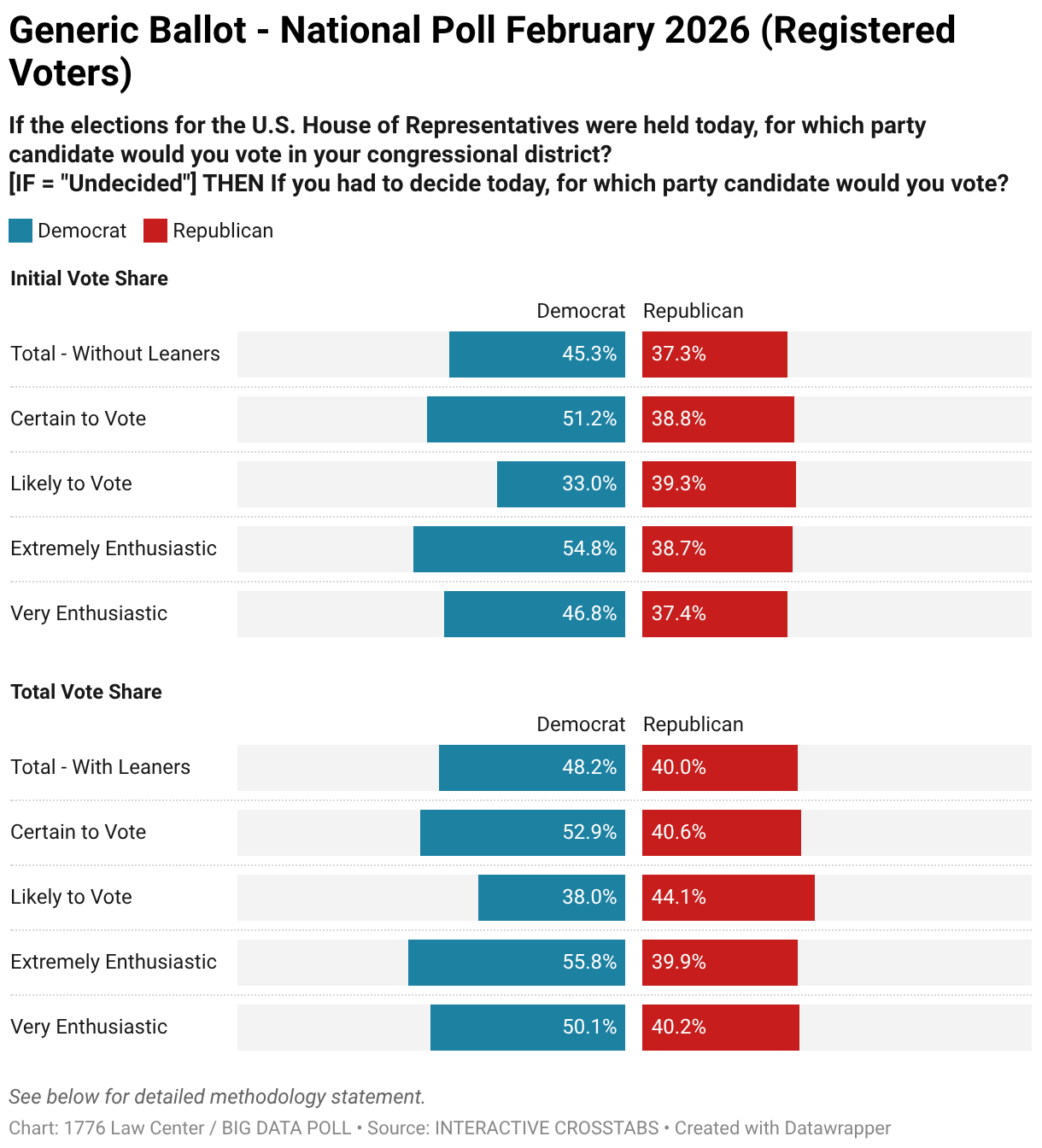
Democrats widened their lead over Republicans on the Generic Ballot in February, solidifying their advantages on certainty and enthusiasm to vote. The survey was conducted by BIG DATA POLL for 1776 Law Center as part of the annual Four Freedoms Poll in partnership with the Public Polling Project.
On the initial Generic Ballot without leaners, 45.3% of registered voters say they would vote for the Democratic candidate and 37.3% say they would vote for the Republican candidate. That’s a marginally stronger lead than the initial 46.1% to 42.0% advantage Democrats enjoyed in the first poll of 2026 in January and the 44.9% to 41.8% edge Democrats enjoyed in the final poll of 2025 conducted in December.
Of those “Certain to Vote”, Democrats now lead 51.2% to 38.8%, expanding their 48.1% to 43.1% margin from last month. Democrats have also expanded their lead among those who are “Extremely Enthusiastic” to vote, now up to 54.8% to 38.7% from 53.6% to 41.8%.
Presidential Donald Trump’s Job Approval Rating Continues to Slide
Nearly 13 months to the day into his second term, approval of President Donald Trump has declined to a new all-time low as voter frustration over policy direction further hardens negative opinions. In February, 42.4% of registered voters say they approve of the job the president is doing and 54.6% disapprove. Voters give him more negative marks on every single issue tested monthly, and the percentage of registered voters who “strongly disapprove” of the job he is doing (43.0%) now exceeds the total percentage of those who approve.
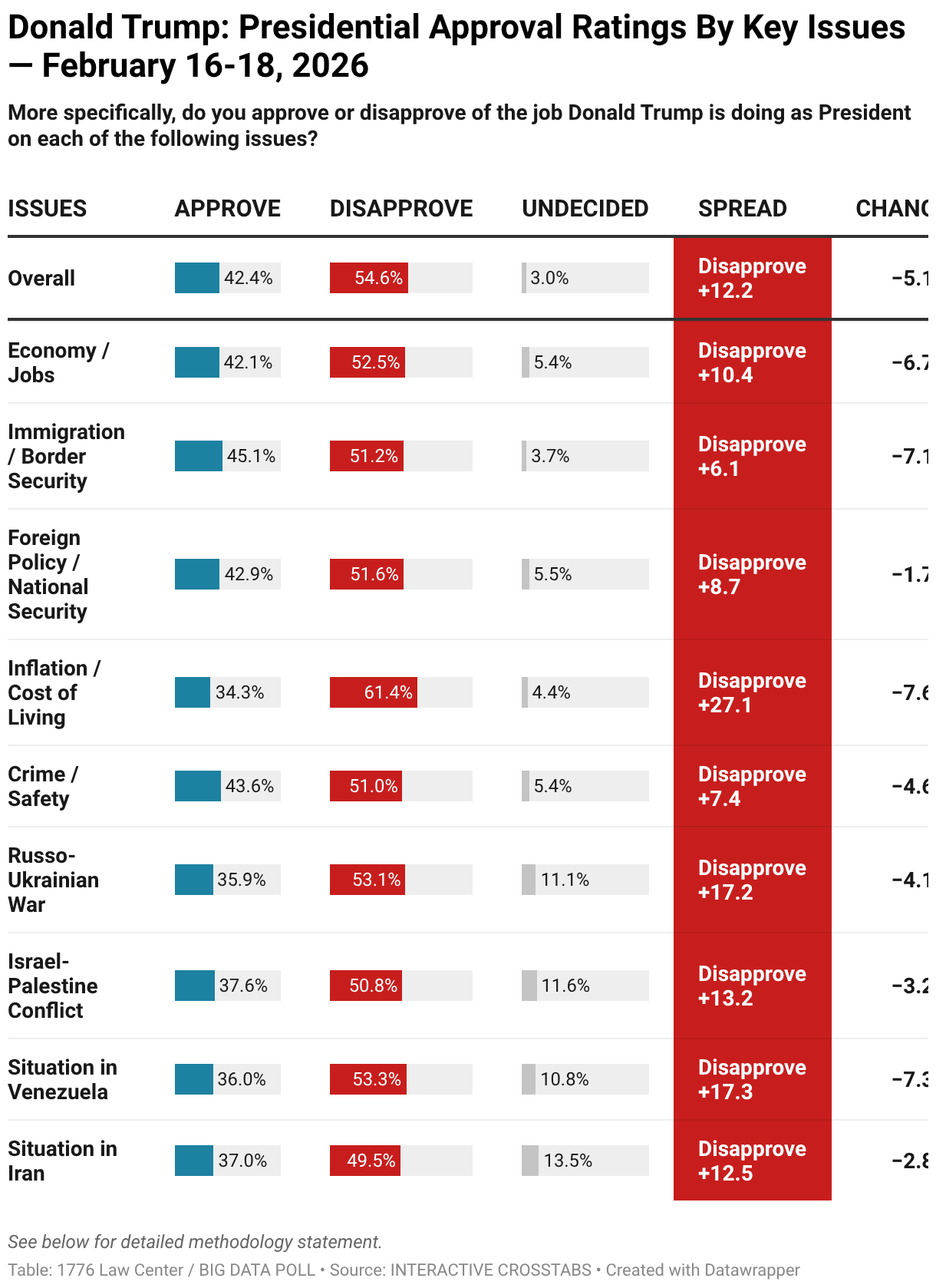
The president entered office this year with an astonishingly high 55.5% approval rating, with only 37.4% disapproval. His numbers fell but remained fairly strong until May, and collapsed after the administration pivoted to foreign policy and the bombing of Iran’s nuclear sites on behalf of Israel. His approval rating bottomed out in late October before recovering somewhat toward the end of 2025. Though the president’s approval rating improved slightly in December, the Intensity Index remained fairly negative (-14.1) and widened to -18.6 in January.
The Intensity Index now stands at -22.3, the most negative reading of his entire second term. Visit and review trends in “How Voters Grade the President’s Report Card” at Donald Trump’s Presidential Job Approval Rating.
White House Focus Tracker
Last year, motivated by repeated concerns raised by voters during interviews, BIG DATA POLL created the White House Policy Focus Tracker. It directly gauges voters’ views towards the administration’s, and indirectly measures the where voters prefer the administration to focus their efforts.
In February, the percentage of voters who said the administration is “too focused on foreign policy” came in at 55.3%, down just one point from the all-time high 56.3% in January. Only 17.9% say they are too focused on domestic issues, though that’s up from 14.7%, and just 26.8% say the focus has been balanced, down from 29.0%. This should be particularly concerning for the administration and Republicans given the top five most important voting issues in our 2026 Rank Distribution for Most Important Issues are all domestic issues.
Direction of Country: Right Track OR Wrong Track?
The Direction of Country Index started the year with 36.3% saying the country is headed in the right direction, essentially unchanged from the year-end reading at 36.1%. That percentage is now down to just 33.6%, the lowest since former President Joe Biden left office in January 2025. Further, the percentage of registered voters who say it’s off on the wrong track hit 57.0%, the highest since December 2024 and up from last month’s reading at 53.6%. That also marks the widest negative spread since January 2025 at -23.4 versus -14.1 in the middle of the month.
Prior to the country electing President Trump in November 2024, only 27.7% said the country was headed in the right direction, while 60.4% said it was off on the wrong track. Simply put, the -32.3 Direction of County spread was cut in half during the president’s first year in office.
Voters Place High Value on Anti-War Candidates, Report Little Appetite for War
More than seven in ten (70.9%) voters say “it is important for the U.S. to stay out of foreign wars and military conflicts”, including 30.9% who say it’s “very important” and 40.0% who say it’s at least “somewhat important.” The results come as the president weighs military action against Iran. Last July, BIG DATA POLL found only 24.6% of voters supported such a move in the Middle East, with roughly as many 25.6% saying they believe the U.S. should play no role in the region. The largest percentage and plurality (37.7%) preferred only diplomatic action.
Which party voters trust to avoid war—or, as stated “to keep the U.S. out of foreign wars and military conflicts”—has long foreshadowed popular vote winners both statewide and nationally in surveys conducted by BIG DATA POLL. It was the first sign of trouble for then-incumbent President Trump in 2020 in the Big Six Rust Belt Poll. In 2024, the results forecasted the winner nationally and all battleground states to include nearly identical findings in Michigan and Pennsylvania.
When asked which party they trusted more to avoid war, Democrats held an 8-point advantage, 38.8% to 31.4%, though roughly one in five (19.9%) trust “neither” party to do so. About one in 10 (9.9%) were undecided.
Methodology
The Public Polling Project conducted by BIG DATA POLL interviewed 2,012 registered voters and 1,805 likely voters nationwide from February 16 to February 18, 2026. Interviews conducted online are sourced through Lucid (CINT) and live-agent phone interviews including P2P SMS and text-to-online are sourced from the L2 National Voter File Database. Participants who opted for text-to-online were given 24 hours to complete the interview. Interview details plotted on maps can be reviewed by hovering and clicking on the locator pins. Results were weighted for sex, age, race and ethnicity, education, and geography. The overall sampling error is ±2.1% for the registered voter sample and ±2.3% for the likely voter sample at a 95% confidence level. It is important to note that sampling errors for subgroups are higher. All BIG DATA POLL publicly conducted surveys are crowdfunded via the Public Polling Project, supplemented if necessary by BIG DATA POLL and are NOT funded by or affiliated with any candidate, campaign, committee, or political entity. This survey was conducted with partner sponsorship from 1776 Law Center. Full and interactive crosstabs can be viewed on MarketSight. The Four Freedoms Poll is an annual partnership with the Public Polling Project sponsored by 1776 Law Center to gauge support and/or opposition to issues relating to food, financial, medical and political freedoms. 1776 Law Center helps those who cannot afford counsel and public advocates to obtain capable, competent counsel and public advocates, especially when their case broadly impacts civil liberties.