
First Ever Public Study on the Impact of UFO/UAP Disclosure Suggests Stereotypes Are Wrong, Doomsday Predictions Unfounded
Since The New York Times first reported on the Advanced Aerospace Threat Identification Program (AATIP) in 2017, BIG DATA POLL has asked adults and registered voters four questions annually about their views on Unidentified Flying Objects (UFOs), or what the U.S. government refers to as Unidentified Anomalous Phenomena (UAP).
But for the nation’s 250th Birthday, the 30-year anniversary of the original movie “Independence Day” and amid President Donald Trump’s unprecedented effort to declassify decades of data regarding the UFO/UAP phenomena via the Department of War (DOW) and Office of the Director of National Intelligence (ODNI), BIG DATA POLL conducted the first ever public survey attempting to determine the impact on society due to Alien Disclosure.
“There is a lot to unpack from this study both in terms of the data collected for this study and potential contributions it may make to future studies on the subject,” BIG DATA POLL Director Rich Baris, said in a statement. “However, the data painted a clear enough picture to state with confidence that stereotypical assumptions are wrong, and previous doomsday predictions in the event of a hypothetical Alien Disclosure scenario, are outdated.”
“That is, assuming they were ever true or appropriate even for prior generations, which too is now debatable.”
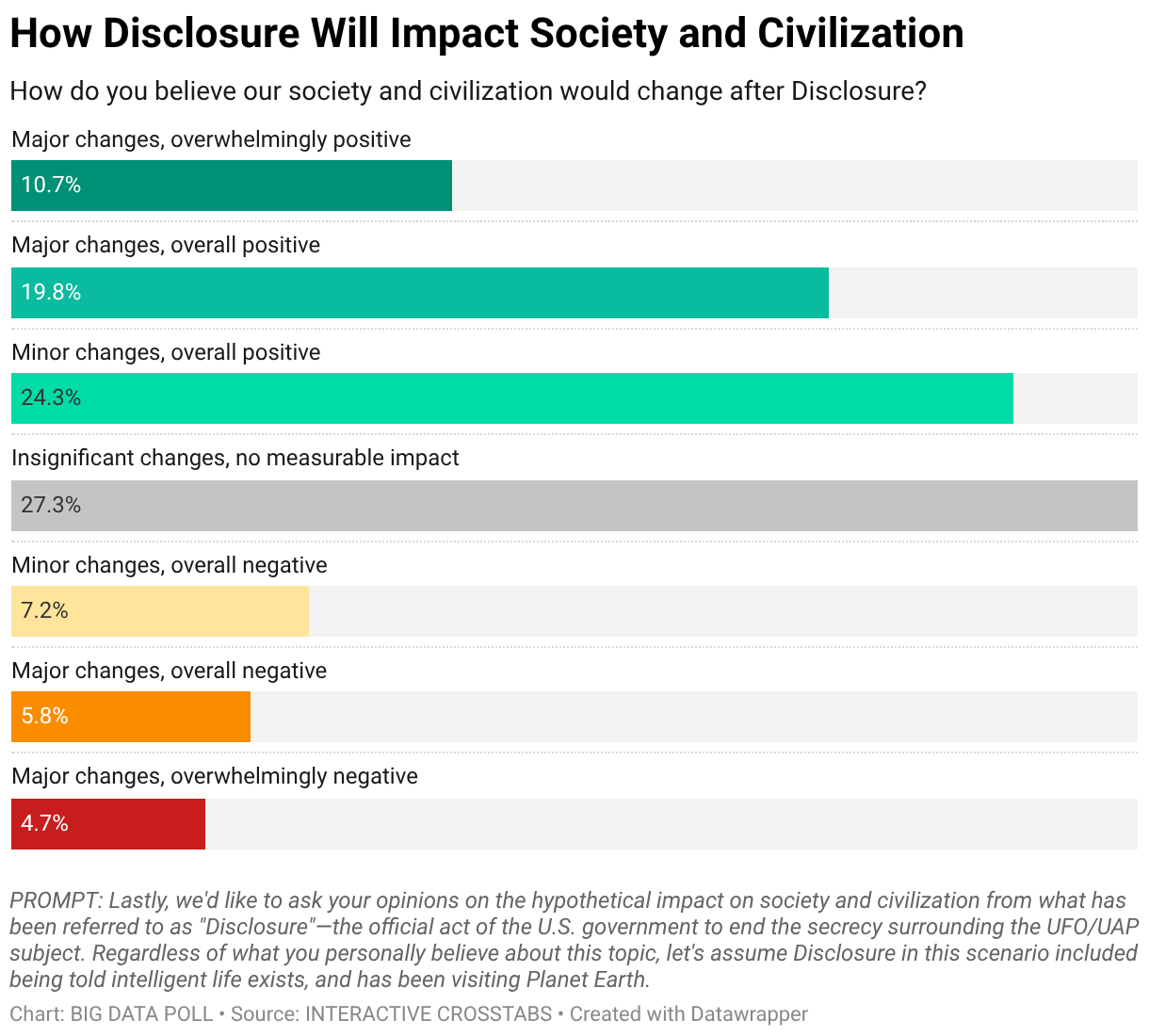
More than 8 in 10 (82.1%) say Alien Disclosure would have an overall positive impact on society and civilization or no measurable impact, including a majority (54.8%) who say it would be decidedly positive to varying degrees of impact and positivity. For the purpose of the study, Disclosure was defined as “the official act of the U.S. government to end the secrecy surrounding the UFO/UAP subject” and confirmation “intelligent life exists, and has been visiting Planet Earth.”
The study also attempted to measure a threshold for belief in Disclosure. Simply put, “What would it take for you to believe Disclosure?” Interestingly, party affiliation and sex dictate more than other core, non-nested demographics whether someone indicates a presidential confirmation would suffice. Only about 2 in 10 say that they would never believe Disclosure as it was presented in this hypothetical, which is interesting given roughly the same does not believe intelligent life exists elsewhere in the universe and a nearly identical amount is unsure.
“Seeing is definitely believing,” Director Baris noted. “Those who witness a UFO/UAP are obviously more inclined to believe an act of Disclosure by the government, but Americans require proof to varying degrees.”
A central claim made by whistleblowers since the report on the Advanced Aerospace Threat Identification Program (AATIP) is that Unidentified Anomalous Phenomena (UAP) have been interacting with various elements of the U.S. military for decades and with higher frequency over time. This latest research, as well as prior years in which this question was posed to respondents, does show that members of the U.S. military and veterans report witnessing the phenomena at higher rates than the overall population.

“Our research clearly lends credibility to the claims made by former military and intelligence officials who have testified before Congress,” Director Baris added. “The fact active duty service and veterans report witnessing UFOs/UAP at significantly higher rates than the civilian population and with greater frequency is a hard finding to ignore.”
Only about 1 in 10 (10.8%) members of the U.S. military say they’ve never witnessed a UFO/UAP and neither has anyone they know, a far smaller percentage compared to 60.5% of civilians and 57.7% of the overall population. Meanwhile, 31.7% of active duty and 25.8% of veterans report personally witnessing what they believe to be a UFO, both being higher than the 18.6% of civilians and 19.9% overall.

The study also asked respondents whether they think Disclosure would have a positive, neutral or negative impact on several different areas of society: science, technology, religion, politics, ethics, morality and the economy. On each of the seven areas, more reported Disclosure would have a positive impact on society than a negative impact. Majorities say it would have a positive impact on science (53.5%) and technology (55.1%).
Unsurprisingly, views were closest regarding religion. Still, more say it would have a positive (31.7%) rather than negative (23.5%) impact, with 44.8% saying it would have a neutral impact. Neutral impact scores were higher on politics (47.3%), ethics (47.2%), economy (47.1) and morality (45.6%).
Worth noting, only 26.7% agreed the “existence of alien life disproves the existence of God”, while a significant majority disagreed (54.9%) and another 19.0% were indifferent. Only 26.3% of evangelicals overall and 21.8% of white evangelicals agreed with that statement, a finding that clearly challenges one of the existing stereotypical assumptions.
A separate question related to how Americans see events in civil society unfolding after Disclosure found just 6.5% foresee the typical doomsday prediction playing out, defined as “a complete breakdown in civil society and political order”. The largest single group at 34.8% believe there will be “a short disruption followed by positive developments” after Disclosure, and nearly 6 in 10 believe in various disruption periods followed by positive developments in civil society.
Ultimately, only about 3 in 10 disagree with the statement asserting “human beings are ready for and can handle Disclosure” juxtaposed to 52.9% who agree and 16.0% who neither agree nor disagree.
“No single question can give us an answer to the question of what would happen in the event of Alien Disclosure,” Director Baris concluded. “But looking at what we know and taking it all in concert—which is that more and more people are reporting sightings, Americans believe extraterrestrial life exists elsewhere in the universe, most would see it as beneficial to key areas of society, and very few see it leading to the collapse of society as we know it—I think Americans would rather have the truth regardless of how disturbing they might initially find it.”
“If our hypothetical scenario accurately characterized that truth, then they would be able to handle it just fine.”
Methodology
The Public Polling Project conducted by BIG DATA POLL interviewed 3,005 adults and 2,976 registered voters nationwide from July 1 to July 3, 2026. Interviews conducted online are sourced through Lucid (CINT) and live-agent phone interviews including P2P SMS and text-to-online are sourced from either the L2 National Voter File Database. Participants who opted for text-to-online were given 24 hours to complete the interview. Interview details plotted on maps can be reviewed by hovering and clicking on the locator pins. Results were weighted for sex, age, race and ethnicity, education, and geography. The overall sampling error is ±1.8% for the registered voter sample and ±1.7% for the likely voter sample at a 95% confidence level. It is important to note that sampling errors for subgroups are higher. All BIG DATA POLL publicly conducted surveys are crowdfunded via the Public Polling Project, supplemented if necessary by BIG DATA POLL and are NOT funded by or affiliated with any candidate, campaign, committee, or political entity. Full and interactive crosstabs can be viewed on MarketSight.