
GOP Share of the Electorate Improves Modestly After Midterm Convention
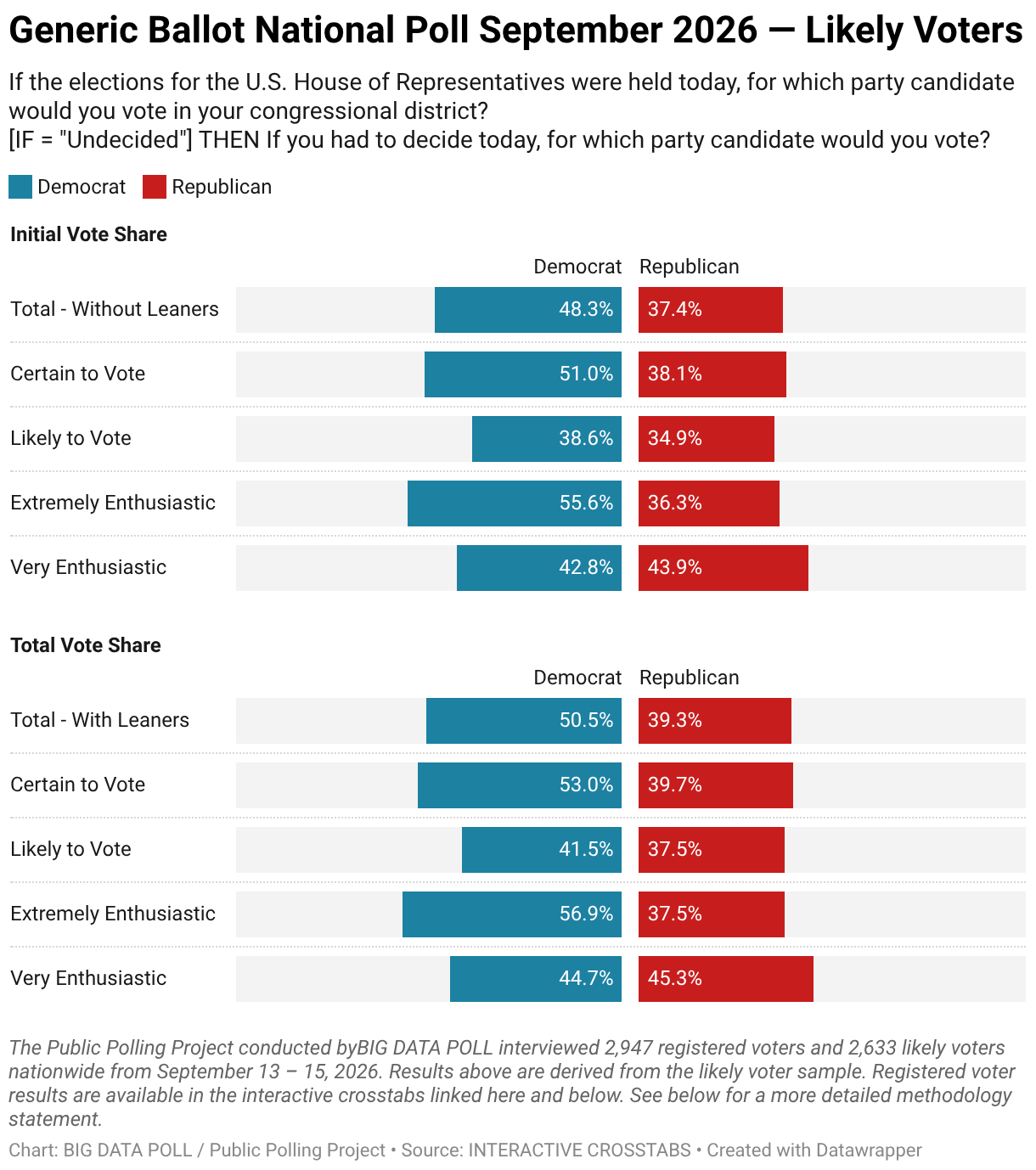
With 48 days until the midterm elections, BIG DATA POLL finds Democrats maintain a clear advantage and Republicans are in danger of losing their majorities in both chambers. The survey was conducted by BIG DATA POLL as part of the Public Polling Project for September 2026.
Generic Ballot for the U.S. House
Democrats continue to hold an 11-point lead (48.3% to 37.4%) on the Generic Ballot for the U.S. House of Representatives among likely voters for the third month in a row. When leaned, the Democrat edge inches slightly higher to 12 points, 50.5% to 39.3%.
While other pollsters are beginning to catch up, Democrats first opened up a double-digit lead in BIG DATA POLL Generic Congressional Ballot tracking in April following the start of the unpopular Iran War. That lead narrowed to single digits briefly after the the president announced the peace deal in June, but widened again in July after the deal fell apart.
“BIG DATA POLL has led the field identifying the durable trends and central story of the 2026 midterm election cycle and these results will not surprise anyone who has been following along,” BIG DATA POLL Director Rich Baris said in a statement. “Voters initially stripped Republicans of their lead on the Generic Ballot immediately following Operation Midnight Hammer.”
“They could not have been more clear about their domestic priorities, opposition to the war and concerns over foreign policy distracting from the cost of living crisis, and it now appears these voters are gearing up to punish Republicans pretty badly for ignoring them.”
Generic Ballot for the U.S. Senate
Democrats also lead 50.4% to 39.1% among likely voters on the Generic Senate Ballot and 52.7% to 39.5% among those “certain to vote” in November. As on the Generic Congressional Ballot, their lead inches higher when undecided voters are leaned, 51.6% to 40.4%.
BIG DATA POLL is currently in the field in eight key states with competitive races for the U.S. Senate, including in Georgia, Iowa, Ohio, Maine, Michigan, Minnesota, North Carolina and Texas.
Presidential Job Approval Rating
President Donald Trump’s approval rating took a big hit in July amid rising gas prices and the collapse of the very popular Memorandum of Understanding (MOU) outlining a peace agreement to end the Iran War. In September, his approval rating only marginally improved on the spread (0.5%), remains deeply underwater and intensity moved against him as views continued to harden.
This month, 38.8% approve of the job he’s doing as president, only marginally changed from 38.9% and that now includes just 18.9% who “strongly” approve. Meanwhile, 58.5% disapprove (marginally improved from 58.9%) and the percentage “strongly” disapproving ticked up 0.1% to 45.7%.
The Intensity Index—the difference between the percentage of those who strongly approve and strongly disapprove of the job the president is doing in office—widened further to -26.8. That’s a new record negative Intensity Index for his second term, eclipsing the -26.3 reading measured in May a few months after the outbreak of the Iran War.
Direction of Country: Right Track OR Wrong Track?
The Direction of Country Index started the year with 36.3% saying the country is headed in the right direction, essentially unchanged from the year-end reading at 36.1%. In July that percentage fell to just 29.7%, tied with May for lowest level since former President Joe Biden left office in January 2025.
The percentage of registered voters who say it’s off on the wrong track hit 61.7%, the highest since August 2024 and up from last month’s reading at 60.5%. This month at -32.9 also marks the widest negative spread since December 2024 at -30.8 compared to just -7.2 in May 2025 before the president bombed three of Iran’s nuclear sites.
White House Focus Tracker
Last year, motivated by repeated concerns raised by voters during interviews, BIG DATA POLL created the White House Policy Focus Tracker. It directly gauges voters’ views towards the administration’s, and indirectly measures the where voters prefer the administration to focus their efforts.
In July, the percentage of voters who said the administration is too focused on foreign policy set a new high at 62.7%, eclipsing the previous record measured in March. This month, that percentage came in at 61.8%, down slightly but still elevated. Only 15.4% said the administration is too focused on domestic issues and not enough on foreign affairs, while just 22.8% say they are striking the right balance.
Final Thoughts
“Republicans are quickly running out of time to improve their outlook for November,” Director Baris added. “This was never complicated. The Iran War is and was always unpopular and nobody should ever have expected voters to be willing to suffer increased economic pain for something they never supported.”
Methodology
The Public Polling Project conducted by BIG DATA POLL interviewed 2,947 registered voters and 2,633 likely voters nationwide from September 13 – 15, 2026. Interviews conducted online are sourced through Lucid (CINT) and live-agent phone interviews including P2P SMS and text-to-online are sourced from either the L2 National Voter File Database. Participants who opted for text-to-online were given 24 hours to complete the interview. Interview details plotted on maps can be reviewed by hovering and clicking on the locator pins. Results were weighted for sex, age, race and ethnicity, education, and geography. The overall sampling error is ±1.8% for the registered voter sample and ±1.7% for the likely voter sample at a 95% confidence level. It is important to note that sampling errors for subgroups are higher. All BIG DATA POLL publicly conducted surveys are crowdfunded via the PUBLIC POLLING PROJECT, supplemented if necessary by BIG DATA POLL and are NOT funded by or affiliated with any candidate, campaign, committee, or political entity. Full and interactive crosstabs can be viewed on MarketSight.